The Singaporean Business Owner's Complete Guide to Operating in the Philippines
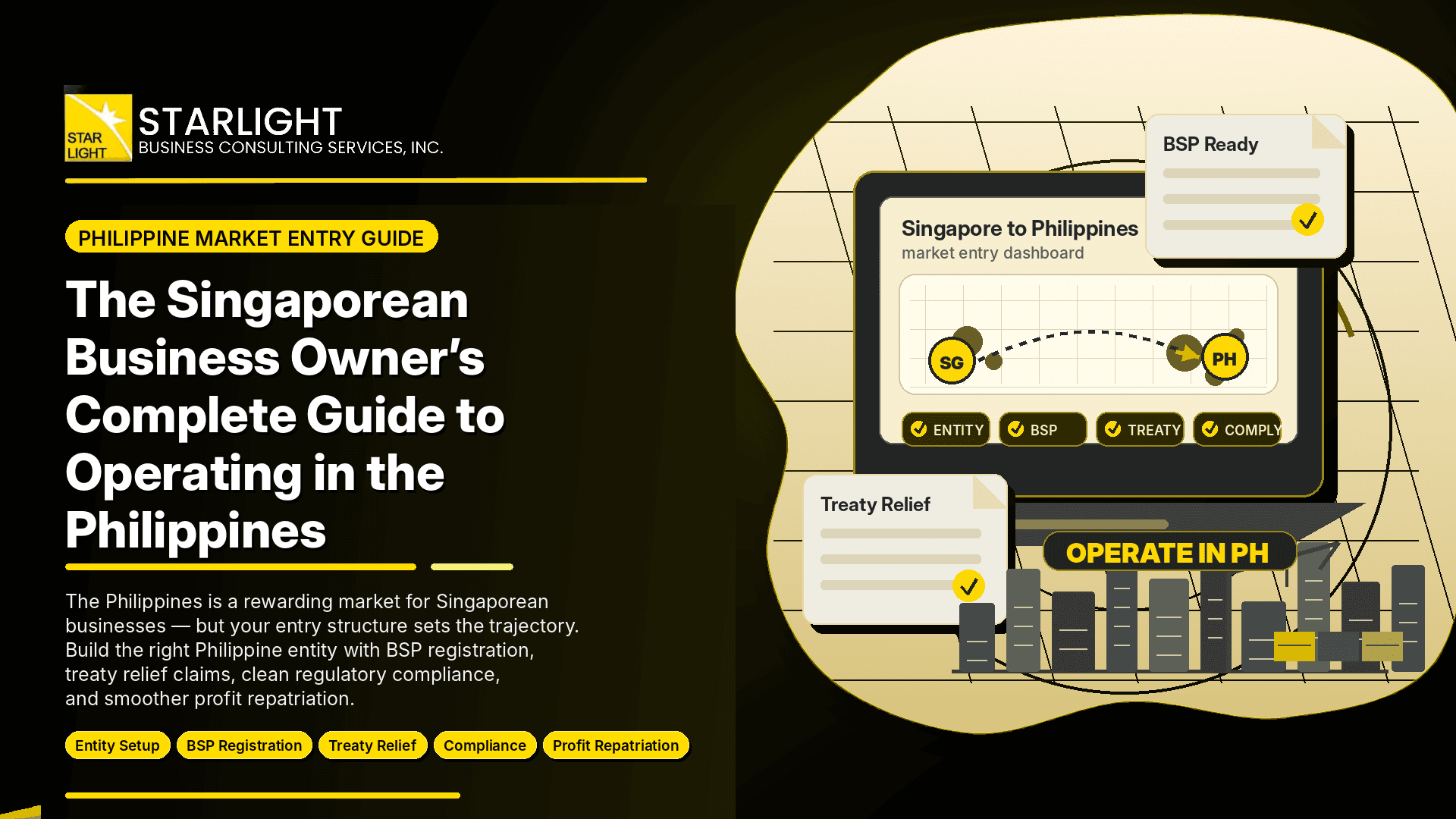
A Singaporean-specific guide to establishing and running a business in the Philippines — covering entity structures, the Philippines-Singapore tax treaty, BSP investment registration, profit repatriation, PEZA incentives, and work permits for Singaporean nationals.
Starlight
Why the Philippines Is Singapore's Most Natural ASEAN Expansion
For Singaporean companies looking beyond their home market, the Philippines occupies a unique position in the regional investment landscape. It is not merely another ASEAN market — it is arguably the most operationally accessible one for a Singaporean business owner.
Japan and Singapore have been among the leading sources of net foreign direct investment received by the Philippines, and Singaporean capital has consistently flowed into Philippine real estate, manufacturing, financial services, and information technology.
But "accessible" does not mean simple. This guide is not a generic foreign investment primer. It is written specifically for Singaporean companies, covering the decisions, documents, tax structures, and compliance obligations that apply to your situation — and that a generic "how to register a company in the Philippines" article would never address.
Part 1: Understanding the Singapore-Philippines Investment Relationship
Singapore's Investment Footprint in the Philippines
Singapore consistently ranks among the top foreign investors in the Philippines by approved investment value, with capital concentrated in several key sectors: business process outsourcing, real estate development, manufacturing, financial services, and increasingly in digital infrastructure and logistics.
This is not a coincidence. It reflects a deliberate bilateral investment framework built over decades — one that gives Singaporean companies structural advantages over investors from non-treaty countries. Understanding this framework is the first step to using it correctly.
The ASEAN Advantage
Singapore and the Philippines are both founding members of ASEAN and signatories to the ASEAN Comprehensive Investment Agreement (ACIA) — a regional investment protection framework that provides Singaporean investors with certain guarantees in the Philippines, including protection against expropriation without compensation, fair and equitable treatment, and national treatment in most sectors.
More practically, both countries operate under compatible business frameworks — common law legal traditions, English-language regulatory environments, and SEC-based corporate governance structures. A Singaporean company director reviewing a Philippine Articles of Incorporation or corporate by-laws will find the document structure familiar.
Part 2: Choosing Your Entry Structure — What Matters Most for Singaporean Companies
The registration requirements for any given entity type in the Philippines are largely the same regardless of the investor's nationality. What differs for Singaporean companies is the strategic context behind each choice and how each structure interacts with the Singapore-Philippines tax treaty and BSP capital registration rules.
The Foreign Investment Negative List: Your First Filter
Before selecting any structure, confirm that your intended business activity is open to foreign ownership under the current Foreign Investment Negative List (FINL). The FINL classifies industries as:
Fully restricted — reserved for Filipino nationals only (e.g., mass media, certain retail activities, small-scale mining)
Partially restricted — open to foreign investors at capped equity levels (40% or 60% foreign ownership, depending on the sector)
Unrestricted — open to 100% foreign ownership
For Singaporean companies, the FINL is particularly relevant in sectors where Singaporean capital has historically concentrated: retail and distribution (subject to capital thresholds), real estate (40% foreign ownership cap in some structures), and financial services (subject to BSP licensing requirements).
Structure 1: Domestic Corporation (Subsidiary)
When Singaporean companies choose this: Long-term market commitment, hiring a significant local workforce, generating income primarily from Philippine customers, or seeking PEZA/BOI incentives.
A domestic corporation is a separate legal entity incorporated under Philippine law — legally distinct from the Singaporean parent. This is critical for two reasons specific to Singaporean investors:
Tax treaty planning. The Philippines-Singapore tax treaty applies to dividends paid by the Philippine subsidiary to the Singaporean parent. Without a separate Philippine corporation, there are no dividends — just branch profit remittances, which are taxed differently. The subsidiary structure gives you more flexibility in how you extract earnings and how you apply treaty relief.
BSP registration for repatriation. When you inject capital from Singapore into a Philippine subsidiary, you must register that inward remittance with the Bangko Sentral ng Pilipinas (BSP) to preserve your right to repatriate profits and capital through the Philippine banking system. Without a BSRD (Bangko Sentral Registration Document), a foreign investor cannot later purchase foreign currency from an authorized agent bank to repatriate dividends, profits, or capital. This registration is done at the time of capital remittance — not later — and Singaporean companies frequently miss this step, creating repatriation difficulties years down the line.
Minimum paid-up capital:
USD 100 — export-market enterprise (at least 60% of revenues from outside the Philippines)
USD 200,000 — domestic-market enterprise (40% or more of revenues from within the Philippines)
Structure 2: Branch Office
When Singaporean companies choose this: Project-based work, testing the Philippine market, or situations where the Singaporean parent prefers to maintain a single consolidated legal entity.
A branch office is legally an extension of the Singaporean parent — not a separate Philippine entity. It can generate income locally, but profits remitted to Singapore are subject to a 15% Branch Profit Remittance Tax (BPRT) before leaving the Philippines.
Key implication for Singaporean companies: If your Philippine operation will be consistently profitable and you plan to remit earnings regularly to Singapore, a subsidiary structure is generally more tax-efficient than a branch — because dividend withholding under the treaty (15% if the Singapore parent holds at least 15% of voting stock) is applied to after-tax profits, while BPRT applies to the full net income of the branch before remittance.
Minimum paid-up capital:
USD 200,000 — standard
USD 100,000 — technology-based activities or 50+ direct employees
USD 100 — export-market enterprise
Structure 3: Representative Office
When Singaporean companies choose this: Market research, product promotion, liaison activities, or supporting the Singapore head office without generating Philippine income.
The representative office cannot earn income from Philippine sources and is funded entirely by the Singaporean parent. It is not subject to Philippine income tax — but it also generates no taxable presence and no treaty benefits. The minimum annual remittance from the Singapore parent is USD 30,000.
This structure is appropriate for Singaporean companies in the reconnaissance phase — evaluating the Philippine market before committing to a full subsidiary or branch.
Structure 4: Regional Headquarters (RHQ) or Regional Operating Headquarters (ROHQ)
When Singaporean companies choose this: Singaporean multinationals managing regional operations across multiple ASEAN markets.
The RHQ/ROHQ structure is particularly popular with Singaporean companies that already have regional operations and want to use Manila as a coordination hub — leveraging the Philippines' skilled English-speaking workforce and lower operating costs relative to Singapore.
RHQ — non-income-generating coordination function; minimum annual remittance of USD 50,000 from the Singapore parent
ROHQ — income-generating from qualifying services to affiliates; minimum annual remittance of USD 200,000; eligible for significant tax incentives
Treaty Rates vs. Standard Philippine Rates
Income type | Standard Philippine rate | Treaty rate (Singapore) | Condition |
|---|---|---|---|
Dividends | 25% | 15% | Singapore parent holds ≥15% of voting stock |
Interest | 20% | 15% | Recipient is beneficial owner |
Royalties | 20% | 15% | Recipient is beneficial owner |
Branch profit remittance | 15% | 15% | No reduction under treaty |
Capital gains (shares) | Varies | Subject to treaty review | Case-specific |
For a Singaporean company receiving PHP 10 million in dividends from its Philippine subsidiary, the difference between the 25% standard rate (PHP 2.5 million withheld) and the 15% treaty rate (PHP 1.5 million withheld) is PHP 1 million per distribution — a material annual saving that compounds across the life of the investment.
Part 3: BSP Investment Registration — The Step Most Singaporean Companies Skip
Why This Matters More Than Most Foreign Investors Realize
Registering your foreign investments with the BSP and obtaining a BSRD enables full and immediate repatriation of capital and remittance of dividends, profits and earnings using foreign exchange to be purchased from Authorized Agent Banks (AABs).
Without a BSRD, a Singaporean parent company wanting to repatriate dividends or recover invested capital from the Philippine entity cannot access the Philippine banking system's foreign exchange facilities to convert pesos to Singapore dollars. It will need to source foreign exchange through other channels — which is significantly more complicated and often impossible at the amounts involved.
How the BSRD Process Works for Singaporean Investors
When a Singaporean parent company remits capital to its Philippine subsidiary or branch:
The capital is received by the Philippine entity through an Authorized Agent Bank (AAB) — any major Philippine bank.
The AAB issues a Certificate of Inward Remittance (CIR) — confirming the foreign currency arrived and was converted to pesos.
The investor submits the CIR along with a cover letter, a completed Application for Foreign Investments form, and other supporting documents to the BSP International Operations Department (IOD) or a select Authorized Agent Bank.
The BSP issues the Bangko Sentral Registration Document (BSRD) — the official record of the registered investment.
The BSRD is retained and presented every time the Singaporean parent seeks to purchase foreign exchange from a Philippine bank to repatriate dividends or capital.
Timing is critical. The BSRD application should be submitted as soon as the capital remittance is received — ideally within the same week. Retroactive registration is possible but significantly more complex and requires additional supporting documentation. Singaporean companies that discover they need a BSRD only when they attempt their first profit remittance face substantial delays and legal complexity.
What Happens If You Skip BSP Registration
Without this registration, finding alternative repatriation channels can be challenging. Specifically, a Singaporean parent whose Philippine entity has no BSRD:
Cannot access Philippine banks' foreign exchange facilities for profit or capital repatriation
Must source foreign exchange through non-banking channels — which are limited in volume and regulatory standing
May face complications during BIR audits, as unregistered inward remittances raise questions about the source of the Philippine entity's capitalization
Has limited recourse if the Philippine entity is later dissolved and capital recovery is sought
Part 4: Setting Up Your Banking Relationship in the Philippines
Choosing a Philippine Bank for Your Operating Account
Singaporean companies establishing a Philippine entity will need a local Philippine peso operating account and, typically, a foreign currency account for receiving international payments and managing the capital remittance and repatriation cycle.
Philippine banks with strong relationships with Singaporean corporate clients and robust trade finance capabilities include BDO Unibank, BPI (Bank of the Philippine Islands), Metrobank, and the Philippine branches of international banks including HSBC, Standard Chartered, and Citibank (now UnionBank-Citi). Some Singaporean companies prefer establishing their Philippine banking relationship with the Philippine branch of a bank they already use in Singapore — which can simplify the account opening documentation process.
Part 5: Ongoing Compliance — Running a Philippine Company from Singapore
What Singapore-Based Directors Need to Know
Many Singaporean companies establish Philippine entities with Singapore-based directors who are not permanently resident in the Philippines. This is permissible under the Revised Corporation Code — directors do not need to be Philippine residents — but it creates specific compliance obligations that Singapore-based directors must actively manage:
Annual General Information Sheet (GIS) filing with the SEC. Every Philippine corporation must file the GIS within 30 days of its annual stockholders' meeting. The GIS discloses current directors, officers, stockholders, and capital structure. Singapore-based directors must ensure they have current, valid identification documents on file with the Philippine SEC — including apostilled copies of their passports or government IDs.
Board resolutions and corporate actions. Philippine law and SEC requirements frequently demand board resolutions for significant corporate actions — opening bank accounts, authorizing signatories, entering major contracts, and declaring dividends. Singapore-based directors should establish a clear process for executing board resolutions with proper apostillation when Philippine regulatory submissions are required.
BIR annual compliance. The Philippine entity's audited financial statements must be filed with both the SEC (via eFAST) and the BIR (via e-AFS) annually. These filings require coordination between the Philippine accountant and the Singapore parent's finance team — particularly for consolidation reporting and transfer pricing documentation.
Transfer Pricing Considerations
Singaporean companies with both Singapore parent and Philippine subsidiary operations frequently have intercompany transactions — management fees, service fees, IP licensing, and loan arrangements. The Philippine BIR requires these transactions to be priced at arm's length, documented in a transfer pricing policy, and disclosed in the BIR transfer pricing documentation report.
Part 6: Common Mistakes Singaporean Companies Make — and How to Avoid Them
Skipping BSP investment registration. This is the single most common and most costly mistake. Singaporean companies that remit capital without obtaining a BSRD discover the problem only when they attempt to repatriate profits — at which point retroactive registration is complex, expensive, and not always successful. Register with the BSP at the point of every capital remittance.
Assuming the tax treaty applies automatically. The 15% treaty rate on dividends and interest does not apply unless you actively claim it — through a valid IRAS COR, a filed TTRA with the BIR, and proper documentation on every income payment. Companies that withhold at the reduced rate without the required documentation face deficiency assessments at the standard rate plus surcharges and interest.
Choosing a branch office for long-term, profitable operations. The branch profit remittance tax is 15% and is not reduced by the treaty. For Singaporean companies planning sustained profitable operations with regular profit repatriation to Singapore, the subsidiary structure — where the 25% dividend withholding is reduced to 15% under the treaty — typically produces a better long-term after-tax result.
Not registering with DOLE before applying for AEPs. The Philippine entity must hold a valid DOLE Employer Registration Number before it can file AEP applications for Singaporean assignees. Companies that place Singaporean executives in the Philippine entity before completing DOLE registration create an illegal employment situation that can trigger enforcement actions.
Underestimating the BIR audit risk at business closure. If a Singaporean company eventually exits the Philippine market and closes its Philippine entity, the BIR will typically conduct a final audit covering all open taxable years before issuing the Tax Clearance Certificate required for SEC dissolution. Singaporean companies with incomplete books, unfiled returns, or unregistered inward remittances face extended and expensive closure processes. Clean, consistent BIR compliance from day one is the most effective exit strategy.
Conclusion: Getting the Foundation Right
The Philippines is one of the most rewarding markets in Southeast Asia for Singaporean businesses — but the quality of your entry sets the trajectory for everything that follows. A properly structured Philippine entity, with correct BSP registration, active treaty relief claims, and clean regulatory compliance from the first month of operations, operates efficiently and repatriates' profits smoothly. An improperly structured one accumulates compliance gaps that compound in cost and complexity over time.
Discover Everything Starlight Can Do for Your Business
From company registration and tax compliance to HR outsourcing, licensing, and corporate branding — our team supports every stage of doing business in the Philippines.
Explore Our Services