Understanding Multi-Country Payroll: How Global Businesses Pay Their Workforce
A comprehensive 2026 guide to how global businesses manages multi-country payroll — covering the processing cycle, regional compliance complexity, full Philippines payroll obligations, EOR delivery models, compliance risk framework
Payroll Advisory Practice
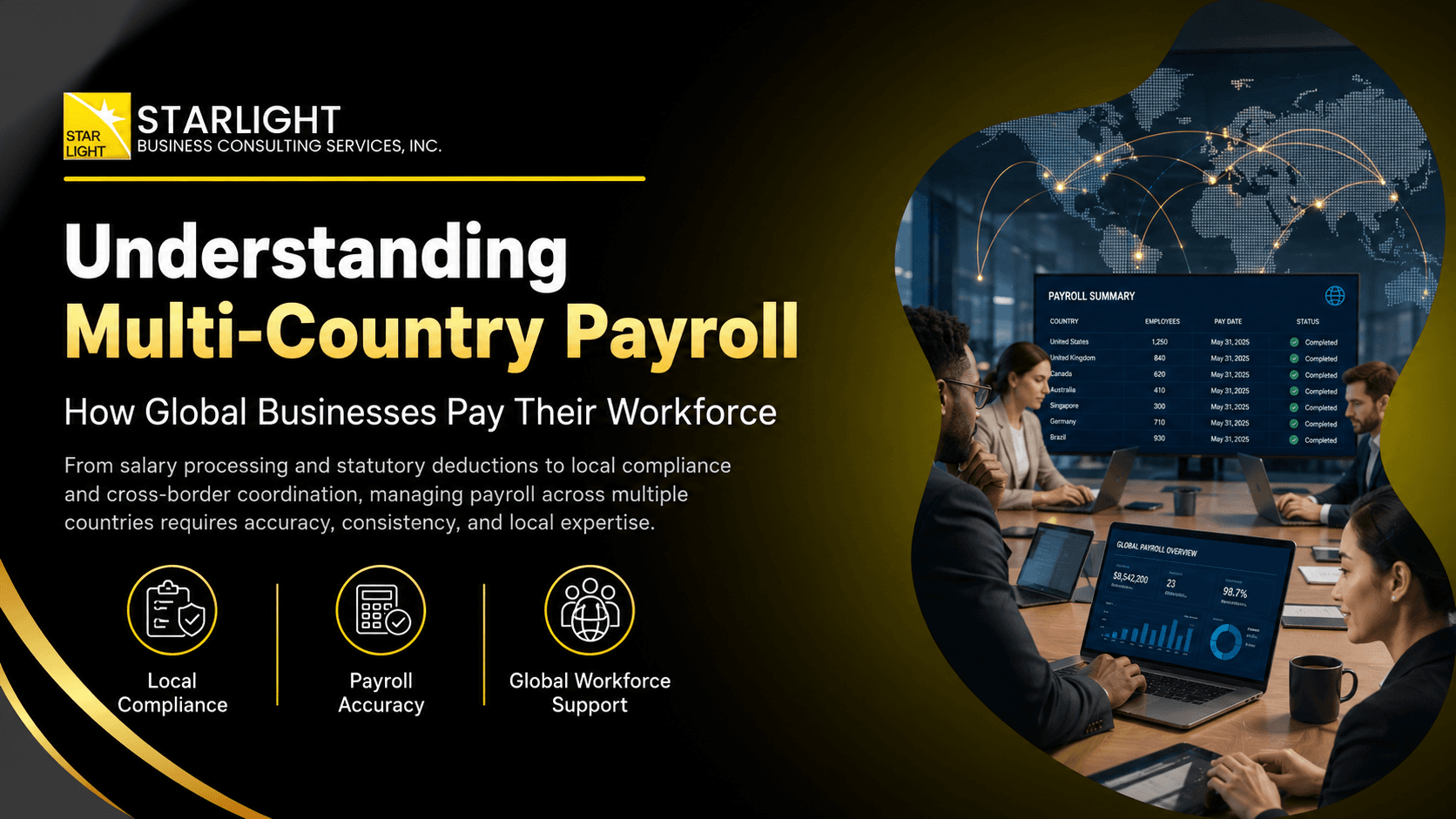
When a company grows beyond its home country, paying its workforce becomes a coordinated global discipline spanning multiple legal systems, tax frameworks, currencies, social security architectures, and data privacy regimes. Understanding how multi-country payroll works — not just that it must work — is the difference between a global organization that scales with confidence and one that accumulates compliance liabilities with every new hire in every new country.
The World Economic Forum's Future of Jobs Report 2025 projects that 78% of companies plan to expand distributed and remote work arrangements through 2030.[1] The International Labor Organization estimates that 169 million people currently work outside their country of nationality.[2] The McKinsey Global Institute forecasts that cross-border labor flows will intensify as demographic imbalances between ageing developed economies and young emerging markets deepen over the next two decades.[3] For every organization hiring across borders, multi-country payroll is not a future consideration — it is an active operational reality.
This article provides an authoritative, comprehensive analysis of how multi-country payroll actually functions — examining the structural elements, regional compliance dimensions, delivery models, technology architecture, and risk framework that define global payroll management in 2026. It is designed for HR directors, CFOs, finance controllers, and operations leaders who need to understand the system they are managing, not just the tasks their payroll team performs.
What multi-country payroll actually consists of.
Multi-country payroll management is the integrated discipline of calculating, processing, distributing, and reporting employee compensation across two or more national jurisdictions — simultaneously, in compliance with each jurisdiction's distinct legal requirements, on each jurisdiction's required schedule. It is not one payroll system applied globally. It is an orchestration layer coordinating multiple country-specific payroll systems — each operating under its own legal logic — into a coherent global function.
The architecture sits at the intersection of five professional disciplines: employment law (what must be paid), tax law (how compensation is taxed), social security law (mandatory contribution obligations), accounting (how payroll costs are recorded and reported), and data protection law (how employee payroll data may be processed and transferred). No discipline can be managed in isolation — a payroll decision made from a pure tax perspective may violate employment law, and a data transfer solution built without legal review may breach data privacy regulation.
The payroll cycle. From data collection to compliance — step by step
Errors at any stage of the payroll processing cycle propagate forward — a wrong input creates a wrong calculation, which creates a wrong payment, which creates a wrong tax remittance, which creates a statutory filing error. The cycle must be managed as a system, not as a series of independent tasks.
The multi-country payroll processing cycle
01 Data collection and change capture — gather all period inputs: new hires, terminations, salary changes, overtime, leave, expense reimbursements, and benefits changes across all countries. Feed through HRIS-to-payroll integrations; manage manual exceptions through controlled data entry.
Data accuracy at this stage determines compliance accuracy downstream. A wrong salary input generates a wrong tax withholding, a wrong contribution, and a wrong pay slip — all requiring correction in subsequent cycles with potential late-payment penalties.
02 Gross-to-net computation — apply each country's current statutory rates: income tax withholding tables, social insurance contribution rates, mandatory deductions, court-ordered garnishments, voluntary deductions, and mandatory benefit accruals (13th-month reserves, leave balances, severance provisions).
03 Pre-payment validation and variance review — generate payroll registers for all countries and perform systematic variance analysis: current period versus prior period for each line item. Variances above defined thresholds require documented approval before the payroll is released.
04 Payroll approval — the authorization gate — obtain formal written approval from designated authorities (country HR lead, regional finance controller, global payroll director) for each country's payroll register before any funds are committed.
05 Currency funding and payment execution — fund payroll bank accounts in local currency, apply exchange rates, execute employee net pay transfers, tax remittances, and social contribution remittances on each country's legally mandated payment date.
06 Payslip generation and statutory filings — issue compliant pay slips in each country's required format and language and file all periodic returns with tax authorities and social security agencies on schedule.
07 Global consolidation and reconciliation — aggregate payroll data from all countries into consolidated reports for group finance and HR. Reconcile the payroll subledger to the general ledger for each entity.
Regional compliance. How payroll obligations vary across the world's major regions
Global payroll complexity is not uniformly distributed. Certain regions impose materially higher compliance burdens, driven by the frequency of regulatory changes, the complexity of social security architectures, the volume of mandatory benefit obligations, and the sophistication of tax authority enforcement. The ASEAN Secretariat's 2024 Labor Market Integration Report found that payroll compliance failures accounted for 41% of reported labor violations by foreign-owned enterprises in ASEAN member states in 2023.[16]
Region | Complexity | Primary Compliance Drivers | Key Regulatory Bodies |
|---|---|---|---|
SE Asia (Philippines, Indonesia, Vietnam, Thailand) | Very high | Multiple contribution agencies per country; 13th-month pay; semi-monthly pay requirements; evolving data privacy laws; foreign worker permits [16] | BIR, DOLE, SSS, PhilHealth, Pag-IBIG (PH); BPJS (ID); SHUI (VN) |
European Union | Very high | GDPR data privacy overlay; country-by-country social contribution variations; works council consultation; Posted Workers Directive for assignments [10] | National tax authorities; DPA supervisory authorities; EU Commission |
North America (USA, Canada, Mexico) | High | US state-by-state payroll taxes (50 distinct regimes); Canada provincial differences; Mexico IMSS/INFONAVIT/SAR and mandatory Aguinaldo (Christmas bonus) [17] | IRS, state revenue agencies; CRA; SAT/IMSS (MX) |
Latin America (Brazil, Argentina, Colombia) | Very high | Brazil's eSocial digital payroll platform; Argentina wage indexation; employer social burden in Brazil approximately 68% of wages [18] | Receita Federal (BR); AFIP (AR); UGPP (CO) |
Middle East & Africa (UAE, Saudi Arabia, South Africa) | Medium-high | UAE Wage Protection System real-time compliance; end-of-service gratuity calculations; Saudi Arabization quotas [19] | MOHRE (UAE); GAZT (SA); SARS (ZA) |
Asia Pacific (Australia, Singapore, Japan, India) | Medium-high | Australia STP real-time ATO reporting; Singapore CPF age-graded rates; India EPF/ESI/TDS; DPDP Act 2023[20] | ATO; IRAS/CPF Board (SG); NTA (JP); EPFO (IN) |
Southeast Asia — the highest-complexity regional payroll environment
Southeast Asia consistently ranks as the most complex regional payroll environment for global businesses. The Philippines alone requires three separate mandatory contribution agencies — SSS, PhilHealth, and Pag-IBIG — with separate remittance deadlines, plus mandatory 13th-month payment, semi-monthly pay frequency requirements, and cross-border data transfer obligations for employee data processed on offshore platforms. The ASEAN Secretariat's 2024 report found payroll compliance failures accounted for 41% of labor violations by foreign-owned enterprises across member states in 2023.
Philippines deep dive. The complete 2026 payroll compliance framework
The Philippines' IT-BPM sector — which generated $32.5 billion in 2023 and employs approximately 1.7 million workers [21] — has made Philippine payroll a priority compliance domain for a growing number of global HR functions. Philippine payroll operates under a distinct multi-agency compliance architecture that differs from most other Asian payroll systems in both its structural design and its enforcement approach.
Income tax withholding (BIR / TRAIN Law RA 10963) [22] — Graduated rates: 0% on annual taxable income up to ₱250,000; 15% on ₱250,001–₱400,000; 20% on ₱400,001–₱800,000; 25% on ₱800,001–₱2,000,000; 30% on ₱2,000,001–₱8,000,000; 35% above ₱8,000,000. Monthly withholding via BIR Form 1601-C. Annual Alphalist (Form 1604-C) due January 31. · BIR / RA 10963SSS contributions (RA 11199) [23] — Employer and employee shares per current 2024–2025 SSS contribution schedule. Monthly remittance: 10th–15th of the following month. Criminal liability under Sec. 28 for non-remittance — 3% monthly penalty on arrears plus possible imprisonment for responsible officers. · SSS / RA 11199
PhilHealth contributions (RA 11223) [24] — 5% of monthly basic salary (2024 rate under the Universal Health Care Act), split equally: 2.5% employer + 2.5% employee. Monthly remittance on the same schedule as SSS. · PhilHealth / RA 11223
Pag-IBIG/HDMF contributions (RA 9679) [25] — Mandatory housing fund contributions. Minimum ₱200/month per employee; higher for earners above the ₱5,000 monthly threshold. Same remittance calendar as SSS/PhilHealth. · Pag-IBIG / RA 9679
13th-month pay (PD 851) [26] — Mandatory statutory payment equivalent to 1/12 of total basic salary earned during the calendar year. Must be paid to all rank-and-file employees on or before December 24. Not a discretionary bonus — a statutory entitlement enforceable by DOLE. Proportional 13th-month pay is due to employees who leave mid-year. · DOLE / PD 851
Pay frequency (Labor Code PD 442, Art. 103) [27] — Employers must pay at least twice a month (semi-monthly) at intervals not exceeding 16 days. Most Philippine employers pay on the 1st and 15th, or the 15th and last day of the month. · Labor Code Art. 103
DOLE payslip requirements — Employers must issue payslips showing gross pay, each deduction itemized (income tax, SSS, PhilHealth, Pag-IBIG, others), and net pay. DOLE inspection teams verify compliance during establishment visits. · DOLE Rules [14]
Data privacy for Philippine payroll data (RA 10173 / NPC) [11] — Employee payroll data constitutes personal information under the Data Privacy Act. Cross-border transfer of Philippine employee payroll data to offshore shared service centers or cloud platforms requires contractual safeguards under NPC Circular No. 2023-04.[28] · NPC Circular 2023-04
EOPT updates (RA 11976, 2024) [29] — VAT returns now quarterly for all taxpayers; reduced withholding tax rates on professional fees under BIR RR 2-2024; new Micro/Small/Medium/Large taxpayer classifications determining filing frequency and payment channel options. · BIR RR 7-2024
"Multi-country payroll is not one payroll system running in multiple countries. It is multiple payroll systems — each with its own legal logic, rate structure, and compliance calendar — that must be coordinated, reconciled, and reported as a single coherent picture of global workforce cost."
The compliance risk landscape across multi-country payroll
Payroll compliance risk in a multi-country programmed varies by risk type, by country, and by the maturity of the organization's payroll governance. The following risk taxonomy is drawn from Deloitte's Global Payroll Survey,[6] PwC's Paying Taxes analysis,[13] and OECD tax compliance research.
Permanent establishment creation | Critical risk | Employing workers without a registered entity may create a PE under OECD MTC Art. 5 — triggering corporate tax obligations that dwarf the payroll costs themselves.[31] |
|---|---|---|
Worker misclassification | Critical risk | Treating employees as contractors — retroactive liability for all unpaid taxes, contributions, and benefits from Day 1. Enforcement intensified across OECD economies 2023–2025. [5] |
Data privacy cross-border transfers | Critical risk | Processing payroll data offshore without adequate safeguards — GDPR fines up to 4% of global turnover; Philippines NPC fines up to ₱5M plus criminal penalties. [10] |
Rate table obsolescence | High risk | Running payroll on outdated tax or contribution rates — Highest risk in countries with frequent mid-year rate changes (Philippines, India, Mexico). |
|---|---|---|
Expatriate double taxation | High risk | Failing to apply bilateral treaty provisions for internationally mobile employees — double income tax in both home and host countries. [32] |
Payslip non-compliance | Moderate risk | Non-compliant payslip content — fines in most jurisdictions; triggers DOLE inspection escalation in the Philippines; basis for employee statutory complaints. [14] |
The strategic imperative
Multi-country payroll management is no longer a back-office function — it is a strategic discipline determining whether a global organization can execute its people strategy with confidence. Every country where an employee is paid is a country where employment law, tax law, social security law, and data privacy law all apply simultaneously — and all carry financial penalties for non-compliance. Organizations that invest in the governance infrastructure, technology architecture, and local compliance expertise required to manage this discipline correctly gain a compounding competitive advantage: the ability to hire and retain talent in any market, at any scale, with the operational certainty that every person will be paid correctly, on time, and in full compliance with local law. Starlight's Global HR and Payroll Advisory Practice provide multi-country payroll compliance frameworks, Philippines payroll structuring, and global payroll technology selection advisory for organizations managing distributed workforces across Asia and beyond.
Ready to register your business in the Philippines?
Whether you are a foreign investor setting up for the first time or an existing company expanding locally, our team handles every step — so you stay focused on your business, not the paperwork.
Talk to Our TeamReferences and authority sources
[1] World Economic Forum (WEF). Future of Jobs Report 2025. Geneva: WEF, January 2025. Chapter 4: Remote and Distributed Work Arrangements (78% projection). weforum.org
[2] International Labour Organization (ILO). World Employment and Social Outlook 2025; Global Estimates on International Migrant Workers 2024; Protection of Wages Convention No. 95 (1949). Geneva: ILO. ilo.org
[3] McKinsey Global Institute. The Future of Work After COVID-19: Cross-Border Labour Flows and Demographic Drivers 2022–2040. New York: McKinsey & Company, 2022. mckinsey.com/mgi
[4] Grand View Research. Global Payroll Software and Services Market Report 2024–2028: Size, Share, and Growth Projections. San Francisco: Grand View Research, 2024. grandviewresearch.com
[5] Organisation for Economic Co-operation and Development (OECD). Taxing Wages 2025; OECD Tax and Benefits Database 2024. Paris: OECD Publishing, 2025. Average employer burden ~40% of gross wages across OECD. oecd.org
[6] Deloitte. Global Payroll Survey 2024: Multi-Country Payroll Delivery Models, Compliance Incidents, and Technology Maturity Benchmarks. London: Deloitte Global, 2024. deloitte.com
[7] International Social Security Association (ISSA). Social Security Programs Throughout the World 2024. Geneva: ISSA, 2024. issa.int
[8] Mercer. Global Benefits and Compensation Survey 2024: Mandatory Statutory Benefits by Country. New York: Mercer LLC (MMC), 2024. mercer.com
[9] Bank for International Settlements (BIS). FX and Cross-Border Payments: Managing Currency Risk in Global Payroll Operations. Basel: BIS, 2024. bis.org
[10] European Parliament and Council. Regulation (EU) 2016/679 — General Data Protection Regulation (GDPR). Brussels: Official Journal of the EU, 2016. Articles 5, 83, 88. gdpr-info.eu
[11] Republic Act No. 10173. Data Privacy Act of 2012. Manila: Congress of the Philippines, 2012. NPC Implementing Rules and Regulations, updated 2023. privacy.gov.ph
[12] International Accounting Standards Board (IASB). IAS 19 Employee Benefits; IAS 21 Effects of Changes in Foreign Exchange Rates — payroll accruals and translation requirements. London: IFRS Foundation, 2024. ifrs.org
[13] PwC / World Bank Group. Paying Taxes 2024: The Global Picture — Payroll Tax Compliance Burden Across 190 Economies. London: PwC, 2024. pwc.com
[14] Department of Labor and Employment (Philippines). DOLE Rules on Payslip Issuance and Payroll Record Keeping; Presidential Decree No. 442 (Labor Code), Article 113. dole.gov.ph
[15] Ministry of Manpower (Singapore). Employment Act — Itemised Pay Slip Requirements; Tripartite Guidelines on Fair Employment Practices 2024. Singapore: MOM, 2024. mom.gov.sg
[16] ASEAN Secretariat. ASEAN Labour Market Integration Report 2024: Foreign-Owned Enterprise Labour Compliance and Payroll Violation Trends. Jakarta: ASEAN, 2024. asean.org
[17] Instituto Mexicano del Seguro Social (IMSS). Cuotas Obrero-Patronales 2024; Ley Federal del Trabajo — Aguinaldo provisions. Mexico City: IMSS, 2024. imss.gob.mx
[18] World Bank Group. Doing Business: Employing Workers Indicator — Brazil Payroll Tax Burden Analysis. Washington D.C.: World Bank, 2023. doingbusiness.org
[19] UAE Ministry of Human Resources and Emiratisation. Federal Decree-Law No. 33 of 2021 (New UAE Labour Law) — Gratuity and End-of-Service Benefits; Wage Protection System (WPS). Abu Dhabi: MOHRE, 2021. mohre.gov.ae
[20] Government of India — Ministry of Labour and Employment. EPF Act 1952 and ESI Act 1948; Digital Personal Data Protection Act 2023 (DPDP Act). New Delhi: MoLE, 2023–2024. epfindia.gov.in
[21] IT and Business Process Association of the Philippines (IBPAP). Philippine IT-BPM Industry Report 2024. Makati: IBPAP, 2024. ibpap.org
[22] Republic Act No. 10963. Tax Reform for Acceleration and Inclusion (TRAIN) Law — revised personal income tax schedules, effective January 2023. BIR Revenue Regulations No. 11-2018; BIR Withholding Tax Tables, updated 2023. bir.gov.ph
[23] Republic Act No. 11199. Social Security Act of 2018 — Section 22 (employer obligations and remittance schedule), Section 28 (criminal penalties: 3% monthly interest on arrears). SSS Contribution Schedule: Circular No. 2023-004. sss.gov.ph
[24] Republic Act No. 11223. Universal Health Care Act. Manila, 2019. PhilHealth Premium Contribution Schedule: Circular No. 2023-0022 (5% total, 2.5%/2.5% split). philhealth.gov.ph
Discover Everything Starlight Can Do for Your Business
From company registration and tax compliance to HR outsourcing, licensing, and corporate branding — our team supports every stage of doing business in the Philippines.
Explore Our Services